Tampere University (TUNI), a long term technology partner for Pulsedeon Oy is proceeding in its pulsed laser deposition roadmap by investing for R&D system allowing development of high performance inorganic materials for protection layers, next generation batteries and fuel cells. High performance industrial applications of glasses and ceramics set prohibitive conditions when it comes to their mechanical requirements. Bending without breaking, or plasticity, and failure tolerance surely bring newly developed solutions closer to current ambitious targets. Plasticity in glasses was observed by Dr Erkka Frankberg (Academy Research Fellow at Tampere University) for amorphous alumina: first for samples in the shape of thin films (https://doi.org/10.1126/science.aav1254), then extended to a larger scale up to the microscale and for high strain rates (https://doi.org/10.1002/adma.202303142). Key for these discoveries was Pulsed Laser Deposition (PLD), a physical vapor deposition technique exploiting the laser-based vaporization of targets to deposit dense and flaw-free films of relevant materials on a substrate.
In Turku University (UTU) research group lead by professor Lippo Lassila is utilizing ultrashort pulsed laser deposition for high performance inorganic coatings e.g. for dental implants and other demanding solutions like critical next generation battery materials. UTU research group and Pulsedeon shall cooperate especially in development of ultrathin ion conducting barrier layers for solid state batteries.
Both Turku University and Tampere University research groups are key scientific partners in VASIKER-project where these PLD units supplied by Pulsedeon are utilized. Fabrication of damage-tolerant glasses and ceramics is a major task in VASIKER – Damage tolerant ceramics in the technology industry project, co-founded by the European union (https://www.tuni.fi/en/research/vasiker-damage-tolerant-ceramics-technology-industry).
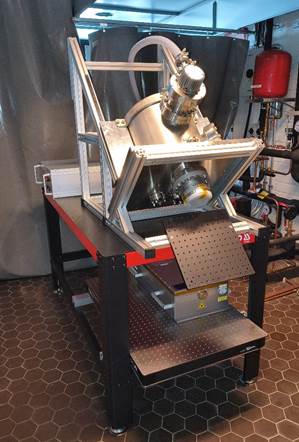
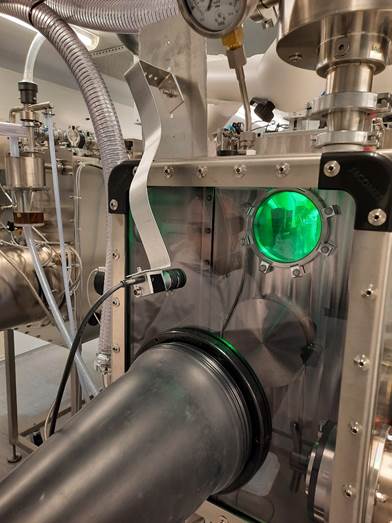
In this framework, brand new PLD setups with tailored functionalities are being developed and supplied by Pulsedeon both for Tampere University and Turku University. This device enables Erkka Frankberg and his team in TUNI and research group of professor Lippo Lassila in UTU to advance the fundamental research on plasticity of glasses and ceramics and bridge the gap between R&D and commercial solutions at the same time. New R&D tool supplied to TUNI is complimented by Coldab S50 deposition tool (Figure 2) transferred to TUNI from Pulsedeon Ii technology center. Pulsedeon is also developing solid state battery raw materials, USPLD target processing technology (see Figure 3.1 and Figure 3.2) and postprocessing technology in its Tampere technology center at TUNI campus area.
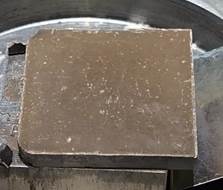
LPS solid electrolyte target
produced at Pulsedeon Tampere technology center for solid state battery program.
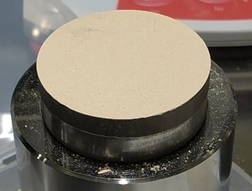
P3N5 target produced at Pulsedeon Tampere technology center for solid state battery program.
For further information:
Ville Kekkonen, CTO
+358 40 5199737
ville.kekkonen@pulsedeon.com